
March 6 & 7, 1999
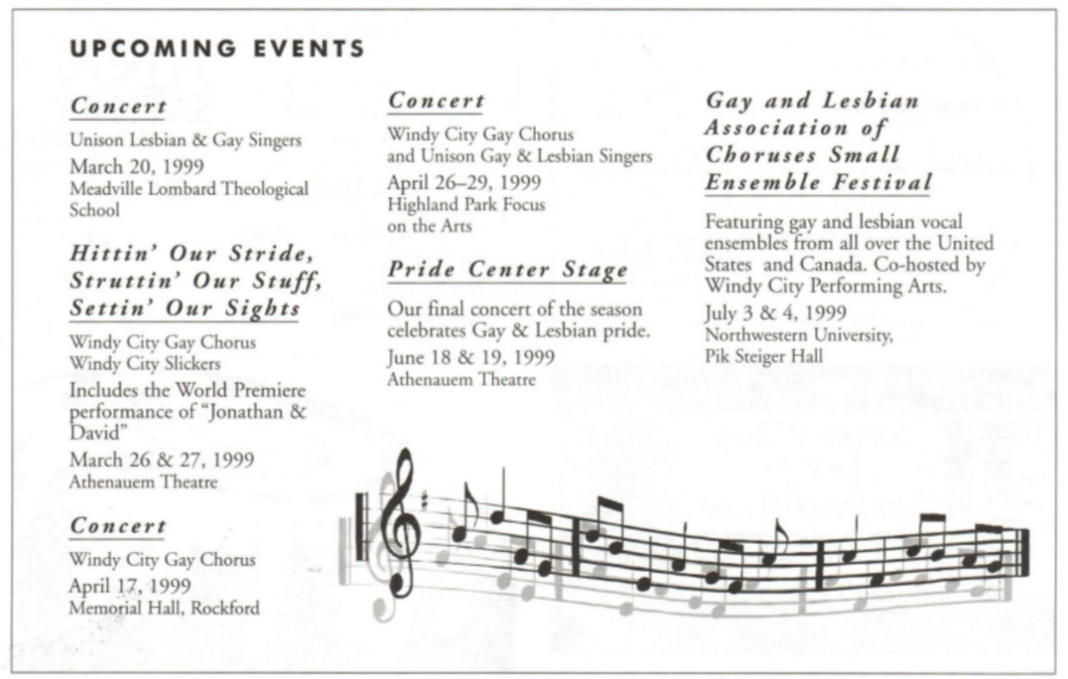
March 26 & 27, 1999

Twixt Heaven & Hell
• UNISON •
Unison attempts to challenge people’s traditional expectations of choral music. Unison debuted at “Don We Now…XIV” in 1992 with 41 singing members, and sang their inaugural concert in April 1993 with recording artists Cris Williamson and Tret Fure as guests.
• ARIA •
Aria creates a new tradition of women’s ensemble singing for the Chicago area. This ensemble has stretched its wings and found its own saucy, sassy voice under the direction of Eric Lane Barnes.
• WINDY CITY GAY CHORUS •
Founded in 1979, Windy City Gay Chorus is recognized as one of the finest volunteer fine arts ensembles in the nation. WCGC is among the first gay male choruses-only San Francisco and New York choruses are older. Known for the highest standard of choral artistry, WCGC fosters gay and lesbian pride through musical excellence. The chorus has appeared around the country at workshops, joint concerts and competitions.
• WINDY CITY SLICKERS •
Since its inception, Windy City Slickers has brought its own brand of spicy musical wit to the Chicago area. This ensemble is under the direction of Eric Lane Barnes.

Click here to view the full concert program!
Hittin’ Our Stride, Struttin’ Our Stuff, Settin’ Our Sights
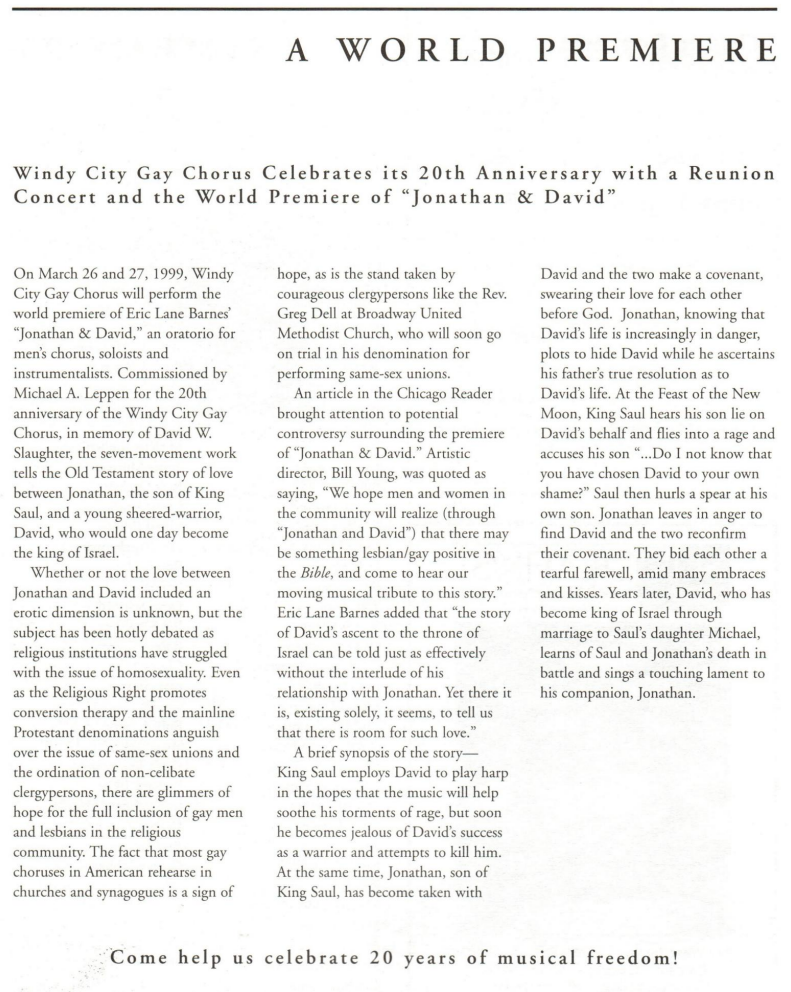
A WORLD PREMIERE
Windy City Gay Chorus Celebrates its 20th Anniversary with a Reunion
Concert and the World Premiere of “Jonathan & David”
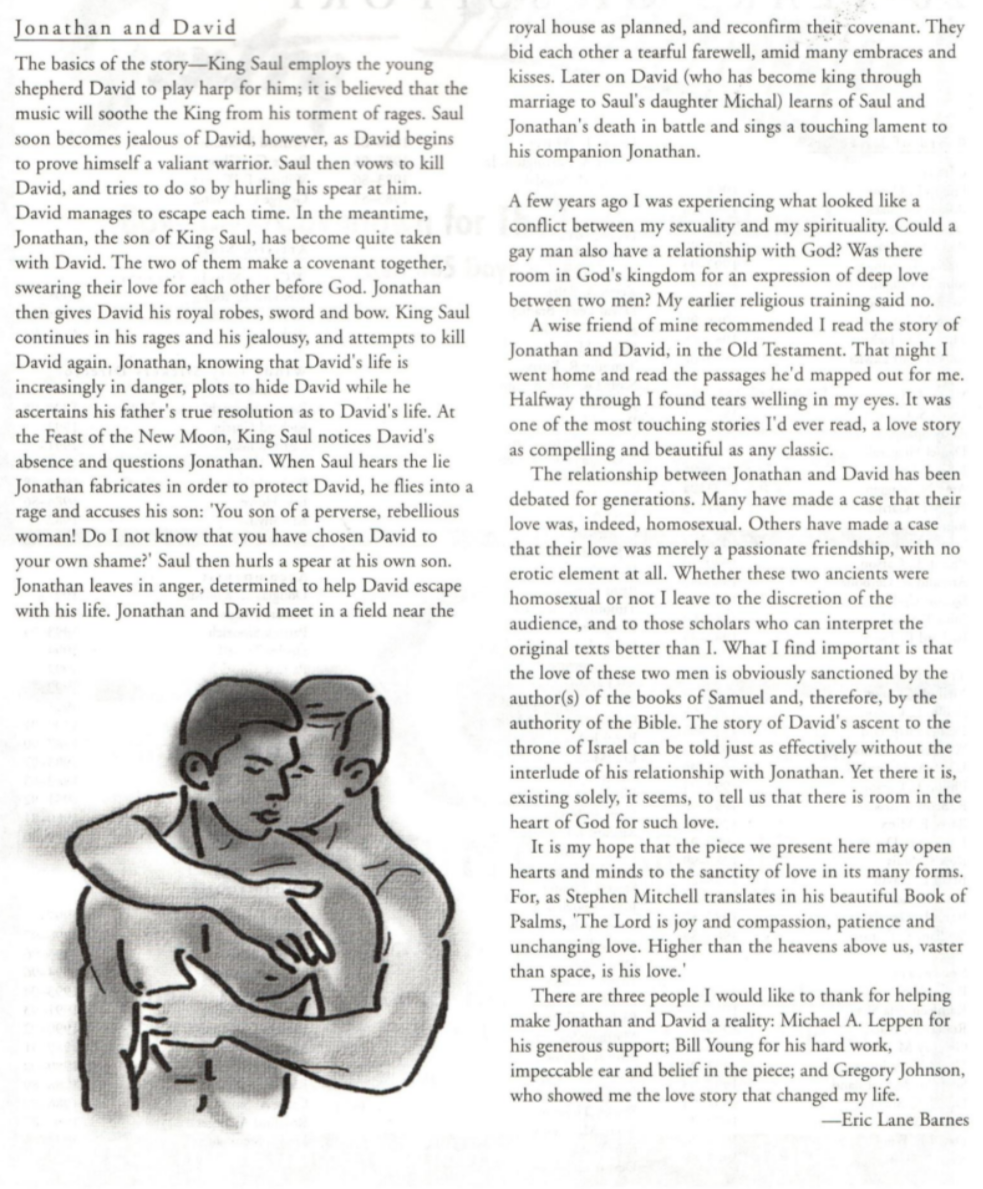
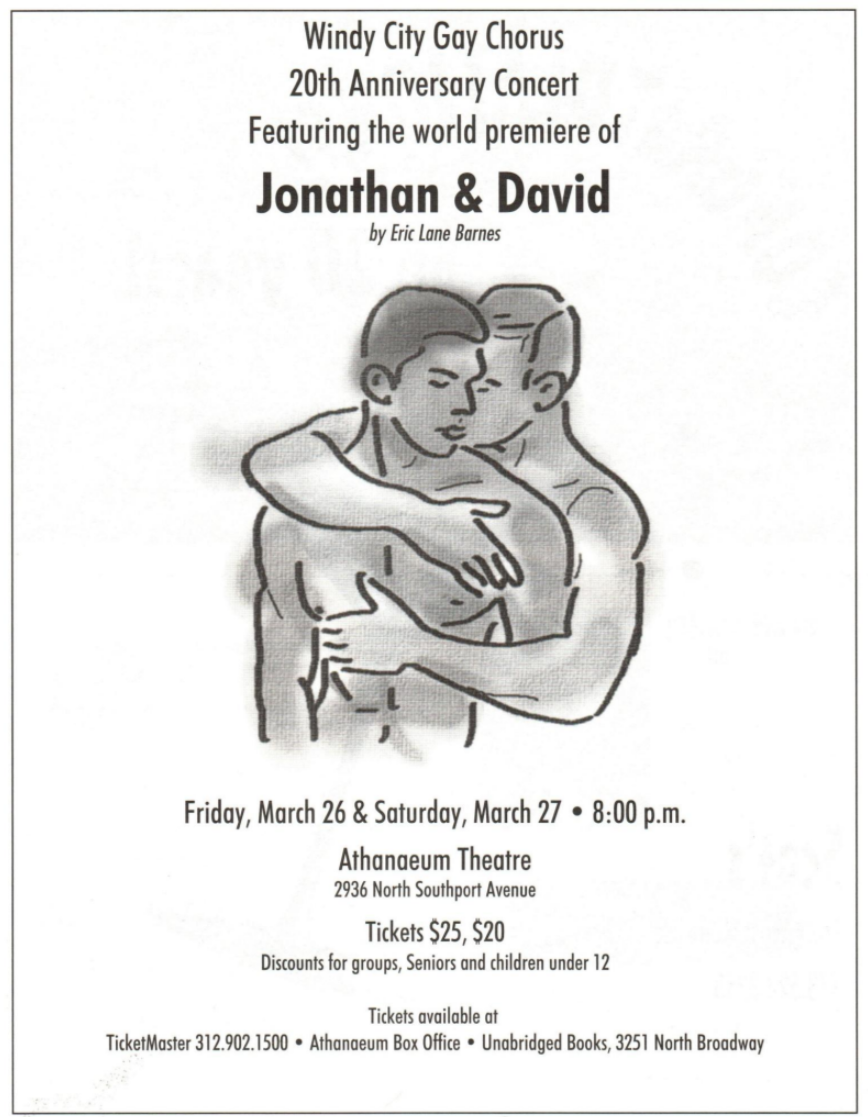
On March 26 and 27, 1999, Windy City Gay Chorus will perform the world premiere of Eric Lane Barnes’ “Jonathan & David,” an oratorio for men’s chorus, soloists and instrumentalists. Commissioned by Michael A. Leppen for the 20th anniversary of the Windy City Gay Chorus, in memory of David W Slaughter, the seven-movement work tells the Old Testament story of love between Jonathan, the son of King Saul, and a young shepherd-warrior, David, who would one day become the king of Israel.
Whether or not the love between Jonathan and David included an erotic dimension is unknown, but the subject has been hotly debated as religious institutions have struggled with the issue of homosexuality. Even as the Religious Right promotes conversion therapy and the mainline Protestant denominations anguish over the issue of same-sex unions and the ordination of non-celibate clergypersons, there are glimmers of hope for the full inclusion of gay men and lesbians in the religious community. The fact that most gay choruses in American rehearse in churches and synagogues is a sign of hope, as is the stand taken by courageous clergypersons like the Rev. Greg Dell at Broadway United Methodist Church, who will soon go on trial in his denomination for performing same-sex unions.
An article in the Chicago Reader brought attention to potential controversy surrounding the premiere of “Jonathan & David.” Artistic director, Bill Young, was quoted as saying, “We hope men and women in the community will realize (through “Jonathan and David”) that there may be something lesbian/gay positive in the Bible, and come to hear our moving musical tribute to this story.” Eric Lane Barnes added that “the story of David’s ascent to the throne of Israel can be told just as effectively without the interlude of his relationship with Jonathan. Yet there it is, existing solely, it seems, to tell us that there is room for such love.”
A brief synopsis of the story: King Saul employs David to play harp in the hopes that the music will help soothe his torments of rage, but soon he becomes jealous of David’s success as a warrior and attempts to kill him. At the same time, Jonathan, son of King Saul, has become taken with David and the two make a covenant, swearing their love for each other before God. Jonathan, knowing that David’s life is increasingly in danger, plots to hide David while he ascertains his father’s true resolution as to David’s life. At the Feast of the New Moon, King Saul hears his son lie on David’s behalf and flies into a rage and accuses his son ” … Do I not know that you have chosen David to your own shame?” Saul then hurls a spear at his own son. Jonathan leaves in anger to find David and the two reconfirm their covenant. They bid each other a tearful farewell, amid many embraces and kisses. Years later, David, who has become king of Israel through marriage to Saul’s daughter Michael, learns of Saul and Jonathan’s death in battle and sings a touching lament to his companion, Jonathan.
Come help us celebrate 20 years of musical freedom!
• WINDY CITY GAY CHORUS •
15th Anniversary history
1979-1980
Windy City Gay Chorus (WCGC),founded by Jerry Carlson, met for the first time on October 9, 1979, and started rehearsals the following week under the direction of Richard Garrin. The chorus made its concert debut at “Don We Now”, a joint performance with the Chicago Gay Pride Band (CGPB), on December 16, 1979, at Stages Music Hall. WCGC sang its first solo concert on June 22, 1980, at Lake View High School. This season saw the birth of the long standing traditions of holiday caroling at neighborhood locations such as Illinois Masonic Medical Center and local “watering holes” and of WCGC participation in the annual Chicago Pride Parade. This season also saw the creation of Toddlin’ Town Performing Arts, Inc.(TTPA), the umbrella arts organization that included WCGC, CGPB, and the Artemis Singers.
1980-1981
WCGC performed its first concert outside of Chicago at Milwaukee’s Engleman Hall on March 14, 1981. In May, TTPA hosted the International Choral Directors and Managers of Gay Choruses Conference, the predecessor to future conferences organized by the Gay and Lesbian Association of Choruses (GALA Choruses). Windy City Slickers is formed.
1981-1982
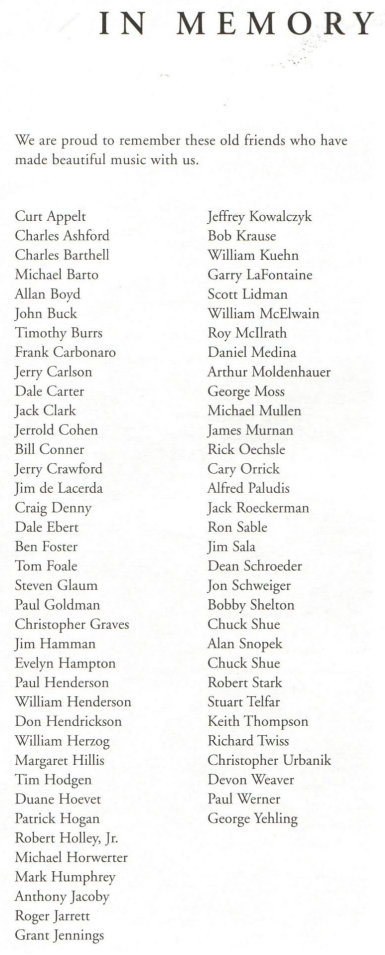
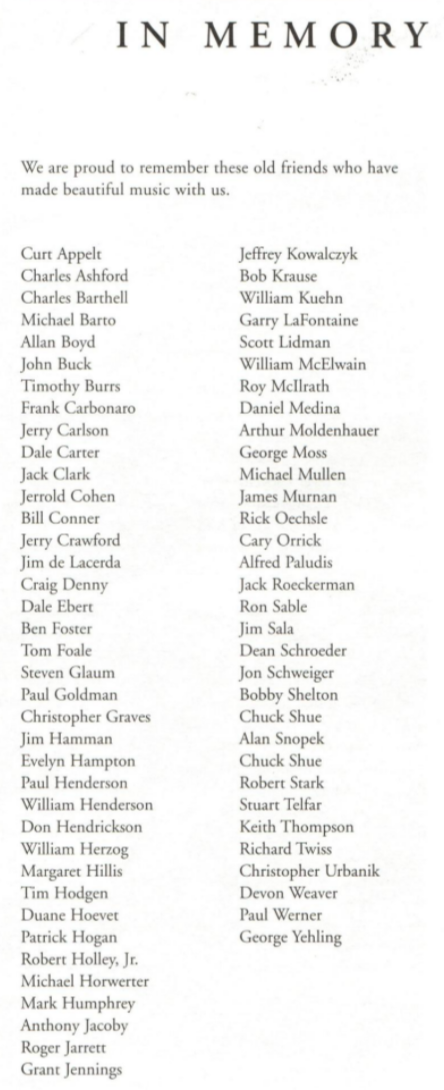
Many in Chicago were saddened by the death of Evelyn Marie Hampton, enthusiastic and beloved member of WCGC, on November 19, 1981. Evelyn was active in raising funds for the chorus’ trip to New York City where WCGC made its debut at Avery Fisher Hall on February 14,1982 in a joint concert with the New York City Gay Men’s Chorus. The New York News wrote on 2/16/82,“a thorough pleasure in tone,balance, precision and sheer joy of singing … the results were positively heroic.” Later that season, the Evelyn Hampton Fund was established to aid WCGC members in meeting the financial requirements of membership.
1982-1983
WCGC terminated its relationship with TTPA to incorporate as Windy City Performing Arts, Inc. (WCPA).The season produced performances with Ginni Clemmens and with the Twin Cities Men’s Chorus and appearances at the Greater Chicago Gay & Lesbian Democrats Rally and Discovery ’82, the Gay Academic Union Conference.
1983-1984
Windy City Gay Chorus won first place at Johnny Mann’s Great American Choral Festival on May 19,1984 at the national finals in Columbus, Ohio. The chorus had previously won first place at the regional competition in Peoria. The Illinois House of Representatives passed House Resolution 1044, congratulating the ensemble, and Mayor Harold Washington lauded the chorus as “a unique asset to the cultural life” of Chicago. This triumphant season included WCGC performances with Pitzen Brass, with Karen Mason and Brian Lasser, and with the Twin Cities Men’s Chorus at Orchestra Hall in Minneapolis. It also heralded WCGC’s first commissioned work, Civil War Songs by Clark Eastham.
1984-1985
WCGC mourned the passing of William O. Henderson, the first of dozens of members lost to AIDS on May 7, 1985. The chorus sang at Chicago Sings Against AIDS, the first of many appearances in support of the fight against AIDS. WCGC made its celebrated debut at Chicago’s Orchestra Hall on June 22, 1985. Banners on Michigan Avenue, bearing “WINDY CITY GAY CHORUS,” announced the performance months in advance. This season the ensemble performed with Audio Express and Pitzen Brass, premiered the commissioned works of A Winter Triptych by James Adler and Three Songs About Love by Ronald Combs. WCGC also appeared at Howard Brown’s 10th Anniversary celebration, the American Choral Directors Association (ACDA) Illinois State Convention in Naperville, the Martin Luther King, Jr. Day concert and ACDA Chicago Sings III.
1985-1986
WCGC was greeted by a standing ovation on April 5, 1986, at the ACDA Central Regional Conference in Indianapolis after winning the fight to sing using its full name, instead of being barred because the word “Gay” was part of the chorus’ moniker. WCGC benefited from earlier litigation brought, and won out of court, by the Gay Men’s Chorus of Los Angeles, then led by director Jerry Carlson, against the Western Division of the ACDA. Later in the season, the ensemble attended its first national GALA Choruses festival, GALA Festival II, in Minneapolis and performed exchange concerts with the Champaign-Urbana Men’s Chorus.
1986-1987
WCGC welcomed guest conductor and founder Jerry Carlson at “Don We Now…VIII” on December 6, 1986. The chorus traveled to Denver to perform an exchange concert with the Denver Gay Men’s Chorus and premiered the commissioned works A Choral Fantasy by Mark Riese and As A Driven Leaf by J. Kawarsky.
1987-1988
This season the chorus went on the road to Champaign to perform with the Champaign-Urbana Men’s Chorus and to Washington to perform with the Gay Men’s Chorus of Washington. WCGC also sang with The Pumps and premiered the commissioned works A Christmas Service by William Kimbel Lyons and Three Pieces After Tennyson by Ron Nelson.
1988-1989
WCGC celebrated its decade of excellence with a 10th Anniversary Reunion Concert on March 18, 1989 at Preston Bradley Center. More than 50 alumni formed the Festival Reunion Chorus for the performance. Later in the season the ensemble premiered the commissioned work Welcome! Sing, Be Merry! by Dean X. Johnson and went on tour to San Francisco to perform with the San Francisco Gay Men’s Chorus and to Seattle for GALA Festival III.
1989-1990
This season WCGC traveled to Detroit to perform with Detroit Together Men’s Chorus and Sistrum: Lansing Women’s Chorus. The chorus performed with The Pumps and MUSE: Cincinnati’s Women’s Chorus and premiered the commissioned work Roll Round With The Year by Alice Parker. The best accolade of the season was June 16, 1990-proclaimed “Windy City Gay Chorus Day” in Chicago by Mayor Richard M. Daley.
1990-1991
WCGC was involved in many outreach efforts this season including appearances at Rush Presbyterian-St. Luke’s Hospital, the first Chicago Walk Against AIDS, the NAMES Project Quilt Display at McCormick Place, the 20th Anniversary of Good Shepherd Parish MCC, the Brown Elephant Resale Shop, the Mayor’s Reception For The Holidays at the Art Institute, Not Just Song & Dance, the Mayor’s Inauguration at Navy Pier, and a Unity Church service. The chorus still had time to premiere the commissioned work Telling It On The Mountain by Samuel Lancaster at “Don We Now XII”, conduct five lengthy recording sessions, and perform “Let Pride Begin, Let Love Continue” in June.
1991-1992
WCGC released its first full-length recording, “Don We Now”; Holiday Favorites, on November 24, 1991 to critical acclaim, and consequently performed their annual holiday concert “Don We Now XIII” that received the following reviews, “every selection exhibiting warmth, delicacy and precision.” (Chicago Sun-Times,12/23/91), and “One of the finest male choruses in the country.” (Chicago Tribune, 12/19/91). The chorus performed with the Chicago Children’s Choir, with Diane Schuur at the Chicago Theater, and with the Chicago Gay Men’s Chorus in “Let’s Call The Whole Thing Off” before traveling to Denver for GALA Festival IV.
1992-1993
At “Don We Now…XIV”; An American Holiday, Unison: Windy City Lesbian & Gay Singers made its debut performance, and WCGC premiered the commissioned work It Came Upon The Midnight Clear; A Christmas Reverie by Conrad Susa. One reviewer wrote, “as close to musical perfection as mere human beings can achieve.” (Gay Chicago Magazine, 12/31/92). The chorus traveled to Washington DC the last weekend of April 1993 to participate in an interfaith prayer service at the National Cathedral, to sing with the San Francisco Gay Men’s Chorus and the Gay Men’s Chorus of Washington, D.C. in Harmonic Convergence, and to perform at the March On Washington rally on the Mall. WCGC returned to Chicago to perform Hidden Legacies by Roger Bourland with the New York City Gay Men’s Chorus and premiere the commissioned work In The Miracle by Gary Simmons.
1993-1994
On November 17, 1993, Richard Garrin was chosen for induction into the Chicago Gay and Lesbian Hall Of Fame. WCGC presented an encore performance of Hidden Legacies, performed at Northern Illinois University and Western Illinois University, and presented the premiere of the commissioned work Letters To The Future by Roger Bourland. This would be Richard Garrin’s last season with WCPA.
1994-1995
Interim music director Patrick Sinozich led WCGC for this season’s Holiday, Spring, and Pride performances. The Windy City Times wrote about the chorus saying, “This is class.” (12/29/94). WCGC also appeared at FOCUS On The Arts at Highland Park High School. On February 18, 1995, WCPA’s annual gala fundraising event, An Evening of Broadway, debuted to great success.
1995-1996
At the beginning of the season, WCPA selected Welborn E. Young as music director of WCGC. Mr. Young’s first concert, “Don We Now XVII” drew rave reviews like, “glorious, precision-honed voices” (Chicago Sun-Times 12/4/95), and “The production’s most memorable and beautiful element is the singing of the Windy City Gay Chorus…” (Chicago Reader, 12/8/95). Members of WCGC performed from November 22, 1995, through January 14, 1996, on-stage in the morality play “Everyman”, directed by Frank Galati, at Steppenwolf Theater. The chorus also performed with members of About Face Theatre Collective before traveling to Tampa for GALA Festival V.
1996-1997
WCGC was honored when the ensemble performed by request at the public memorial service of Joseph Cardinal Bernardin on November 18,1996, at Holy Name Cathedral. The group also performed at the Human Rights Campaign Out-Vote ’96 and returned to Highland Park High School for FOCUS On The Arts. Aria Windy City Women’s Small Ensemble debuts at “Don We Now XVIII”.
1997-1998
WCGC kicked off this season to large crowds for “Don We Now XIX” at the Preston-Bradley Center on the city’s north side to rave reviews. Then it was time to prepare for the exchange concerts with the Indianapolis Men’s Chorus which achieved “wicked fun and tight harmonies” (Gay Chicago Magazine, 4/3/97). WCGC then traveled to Rockford to sing an outreach concert for Charlotte’s Web.
1998-1999
WCPA released its second full-length recording, “Glad Tidings We Bring! A Windy City Holiday”, on November 13, 1998. WCGC performed at the NAMES Project AIDS Memorial Quilt Display at Navy Pier and completed four lengthy recording sessions preparing for the release of WCGC’s 20th anniversary recording,“Legacy”; 20 Years Of Song With Windy City Gay Chorus. Tonight, WCGC celebrates 20 years of musical excellence and premieres the commissioned work “Jonathan and David” by Eric Lane Barnes. Join us on June 18 and 19, 1999, for “Pride Center Stage”!
 Windy City Performing Arts